



OEM Hair Dryer Cost Breakdown: What Really Determines Your Price?
When sourcing from a factory, many buyers ask the same question:
“Why does one OEM hair dryer quote cost $8 while another costs $25?”
Understanding the hair dryer OEM cost structure is essential for making smart purchasing decisions, negotiating effectively, and optimizing your product for profit.
This guide explains every major component behind hair dryer manufacturing cost, helping brands, distributors, and private-label sellers estimate real pricing before requesting quotations.
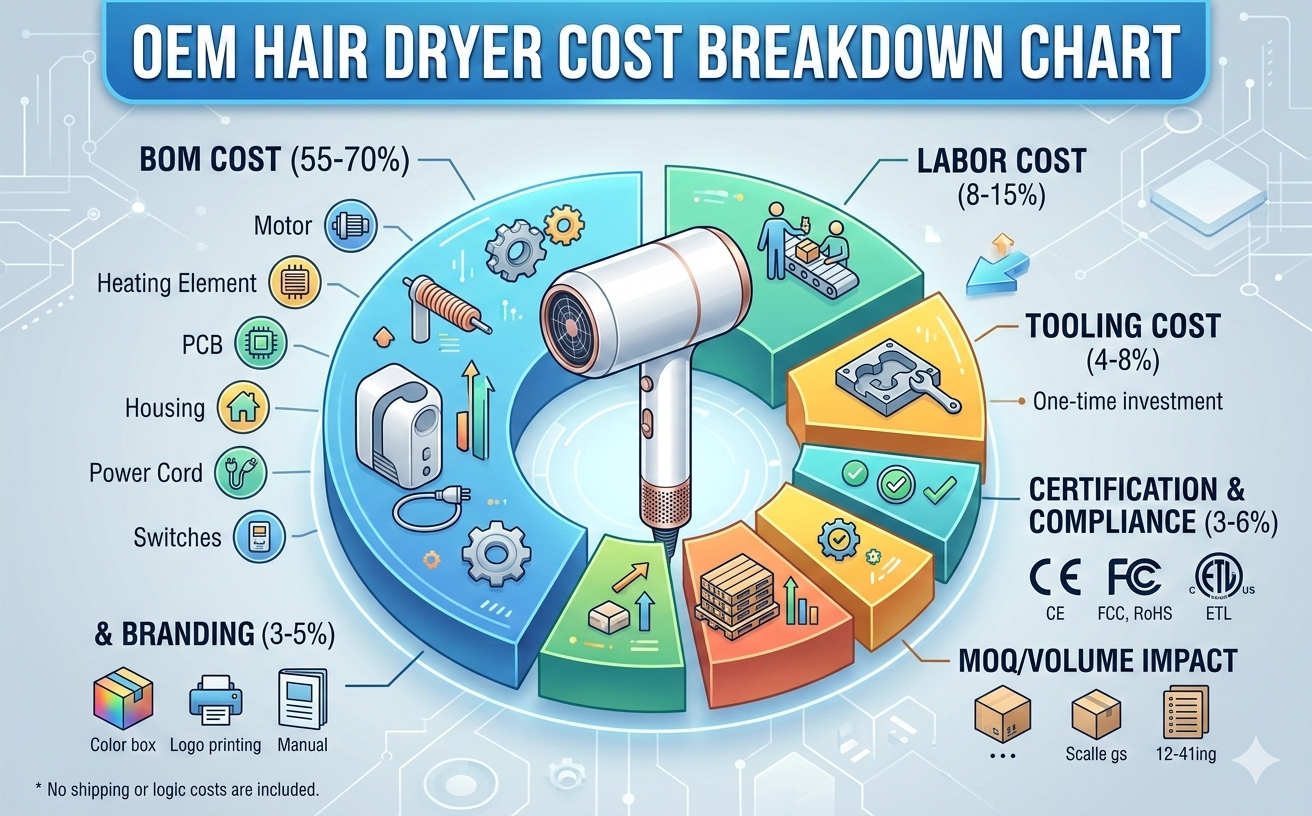
1. BOM Cost (Bill of Materials)
The largest portion of the total price is the hair dryer BOM cost, typically accounting for 55–70% of the unit price.
Key components include:
Motor (AC, DC, or Brushless)
Heating element
Plastic housing
Control PCB
Switches and wiring
Power cord and plug
Nozzles and accessories
Packaging materials
Motor Type Impact on Cost
| Motor Type | Typical OEM Cost Impact | Use Case |
|---|---|---|
| DC Motor | Low | Budget models |
| AC Motor | Medium | Professional dryers |
| Brushless Motor | High | Premium/high-speed |
A brushless high-speed motor can cost 3–5× more than a standard DC motor.
2. Labor Cost in Manufacturing
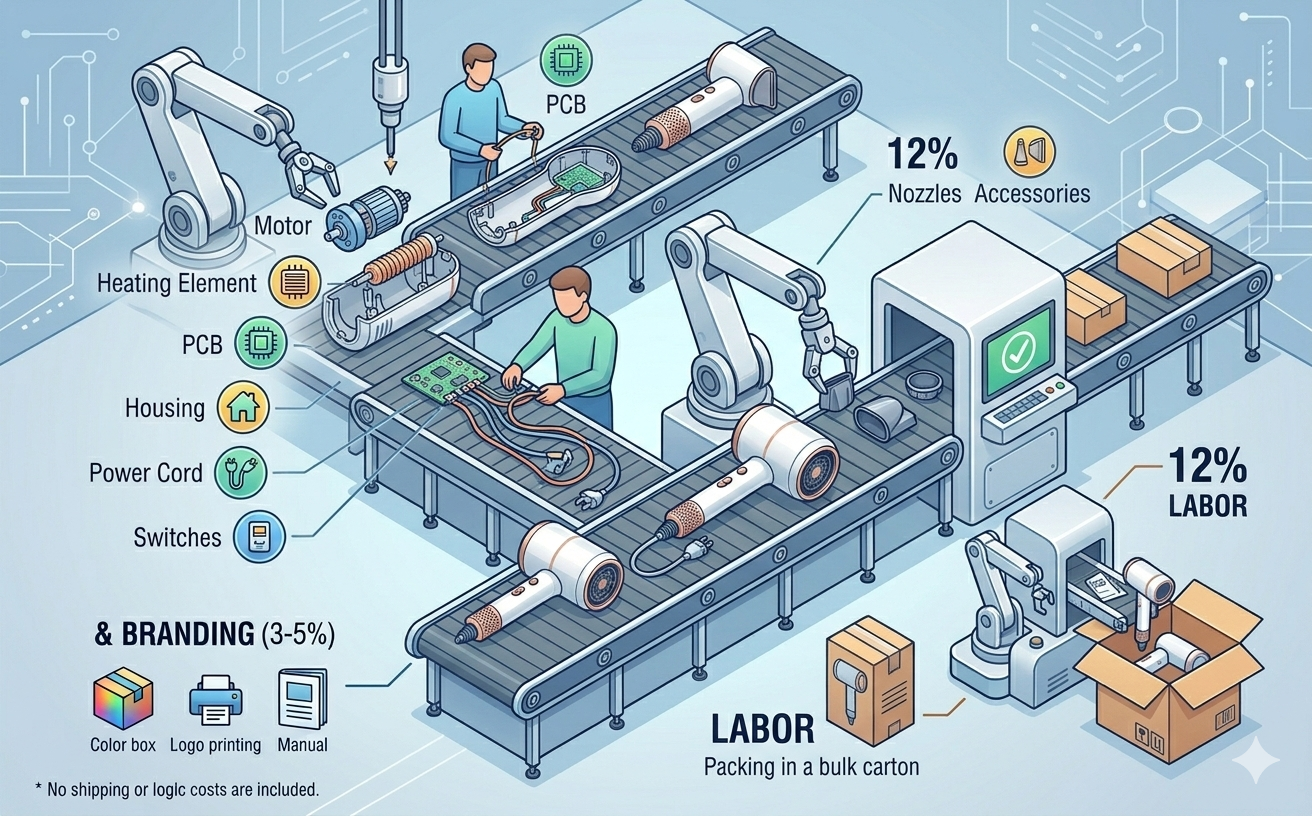
Labor cost manufacturing varies by production complexity and automation level.
Factors that increase labor cost:
Complex assembly processes
Premium finishing or coatings
Manual quality checks
Low automation lines
Small batch production
In China and Southeast Asia, labor typically contributes 8–15% of total OEM pricing.
3. Tooling Cost (One-Time Investment)
Custom molds are required for private label products.
Typical hair dryer tooling cost:
Injection mold for housing: $8,000–$25,000
Accessory molds: $2,000–$8,000
Packaging die lines: $500–$2,000
Tooling is usually paid upfront but amortized across production volume.
Many factories waive tooling fees if large orders are guaranteed.
4. MOQ Impact on Pricing
MOQ (Minimum Order Quantity) strongly influences unit cost.
Why?
Because fixed costs — setup, calibration, tooling wear, testing — are spread across more units.
Example Pricing Impact
| Order Quantity | Estimated Unit Cost |
|---|---|
| 1,000 pcs | High |
| 3,000 pcs | Medium |
| 10,000 pcs | Low |
Higher volume = better purchasing power and lower per-unit manufacturing cost.
5. Certification & Compliance Costs
For EU and US markets, certifications are mandatory.
These costs are often built into OEM quotations:
CE (Europe)
FCC (USA)
RoHS compliance
ETL/UL testing (optional but valuable)
Energy efficiency testing
Certification testing alone can cost $3,000–$15,000, depending on requirements.

6. Packaging & Private Label Branding
Packaging affects both cost and perceived value.
Common options:
Standard export carton (lowest cost)
Retail color box
Magnetic gift box (premium)
Eco-friendly packaging (growing demand)
Branding additions:
Logo printing
Instruction manuals
Barcode labeling
Custom inserts
Multilingual packaging
Premium packaging can add $0.50–$3.00 per unit.
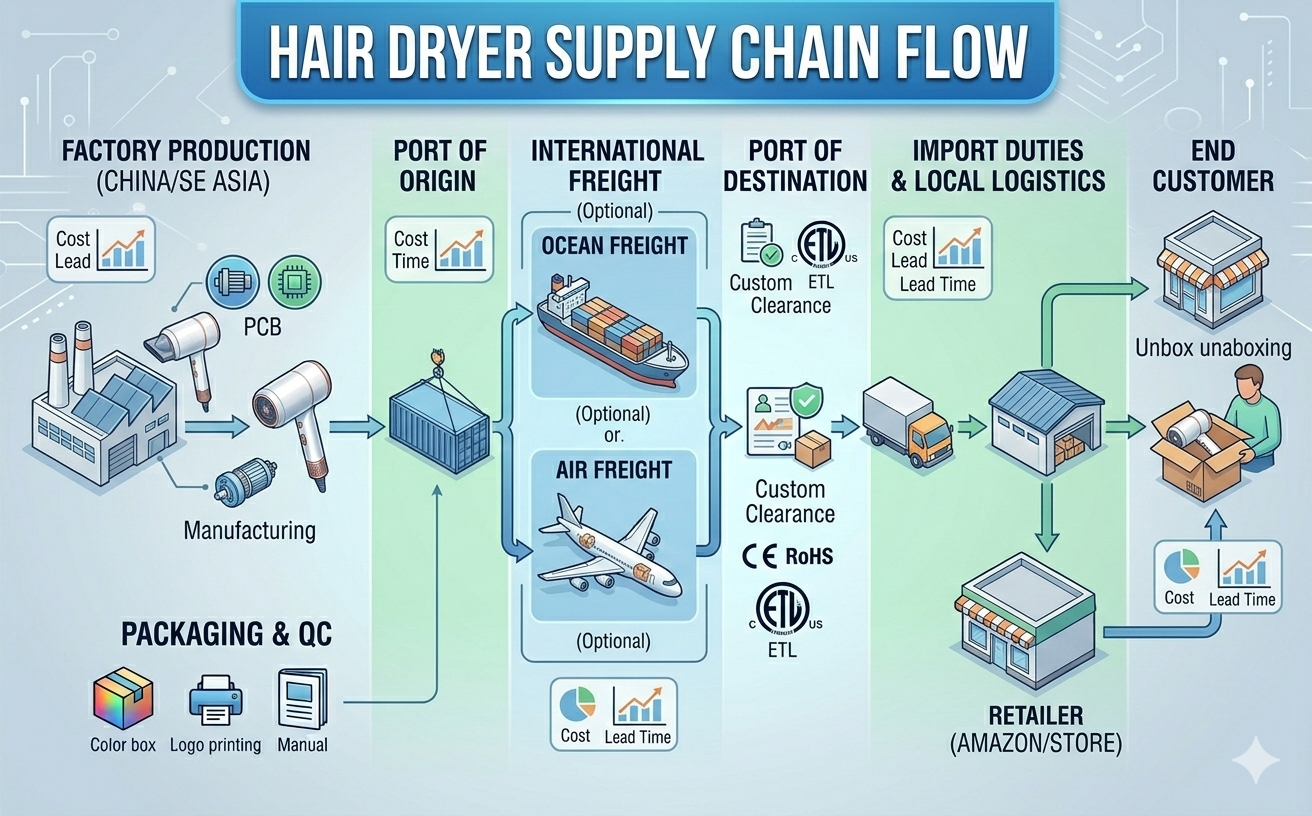
7. Shipping and Logistics (Often Excluded)
Many buyers overlook that factory quotes are usually:
☆ EXW (Ex Works)
☆ FOB (Free On Board)
Additional costs include:
Ocean or air freight
Import duties
Local transportation
Warehousing
Shipping can sometimes exceed manufacturing cost for low-priced products.
8. OEM Pricing Structure Explained
A typical OEM quotation guide includes:
Unit price (based on MOQ)
Tooling fees
Sample cost
Lead time
Payment terms
Packaging specifications
Testing requirements
Always confirm whether costs include:
① Spare parts
② Accessories
③ Manuals
④ Packaging
⑤ QC inspection
9. Private Label Cost Analysis: Budget vs Premium Models
Budget Entry-Level Hair Dryer
DC motor
Basic plastic housing
Standard packaging
Minimal certification
Estimated OEM cost: $6–$10
Mid-Range Professional Hair Dryer
AC motor
Better durability
Retail packaging
Full certifications
Estimated OEM cost: $10–$18
Premium High Speed Hair Dryer
Brushless motor
Advanced noise reduction
Luxury packaging
Advanced electronics
Estimated OEM cost: $18–$35+
10. How to Optimize Hair Dryer OEM Cost
Professional buyers reduce costs by:
⑴ Increasing order volume
⑵ Simplifying product features
⑶ Using existing molds
⑷ Choosing standard components
⑸ Negotiating long-term contracts
⑹ Optimizing packaging size for shipping
Cost optimization should never compromise safety or reliability.
Final Thoughts
Understanding the full cost breakdown hair dryer OEM pricing prevents surprises, improves negotiations, and ensures sustainable profit margins.
The lowest quote is not always the best choice — long-term reliability, quality, and compliance matter far more for brand reputation.
If you are planning a private label or OEM project, request a detailed quotation that clearly outlines all cost components.


